This year, once again, FutureHealth provided a space for exchange, discussion and new perspectives. The event examined opportunities and challenges from an interdisciplinary perspective and focused on the overall system.
The first thematic block, Healthcare in Transition, showed how the healthcare system is evolving between cost pressure, growing complexity and new opportunities. In the second block, the focus was on prevention: experts illustrated the potential for the public, the system and the economy and shared various paths to sustainable implementation. The third block focused on mental health and illustrated why we need a common strategy.
The programme also included a deep dive session by Swiss Post, which showed how IT as a foundation enables smart processes, creating greater scope for patient care.
A strong foundation eases the burden
A stable and clean IT basis is a precondition for digital transformation and consistent processes in the healthcare sector. Pascal Brack, Head of IT Services Digital Health at Swiss Post, opened the session with this key message. This foundation is often invisible in everyday life. However, it is crucial in order for medical operations and digital services to function reliably for patients and specialists.
Pascal Brack shared clear examples of how digital services simplify everyday working life:
-
eTermin and eCheck-in facilitate the arranging of appointments and initial entry of patient data. The information is saved directly in the medical practice software. This saves time and significantly reduces errors.
-
Highly automated logistics processes flow directly into care provision via the Medical Services Center, simplifying, for example, the ordering of operating theatre materials from planning through to invoicing. Hospitals can fully outsource their health logistics to Swiss Post – from operational procurement and storage to case-by-case delivery of consumables, operating instruments and reusable medical devices. Swiss Post also handles the preparation of sterile goods – from cleaning and sterilization to logistics. The result: an integrated solution that simplifies hospital logistics processes, reduces staff workload and frees up capacity.
-
The electronic patient record (EPR), and in future the electronic health record (EHR), is an important step towards greater efficiency and collaboration in care provision. Information relevant to treatment only needs to be entered once. This simplifies processes and improves the quality of medical care. Swiss Post’s eHealth platform provides a secure and user-friendly environment for managing health data and simplifying exchange between specialists.
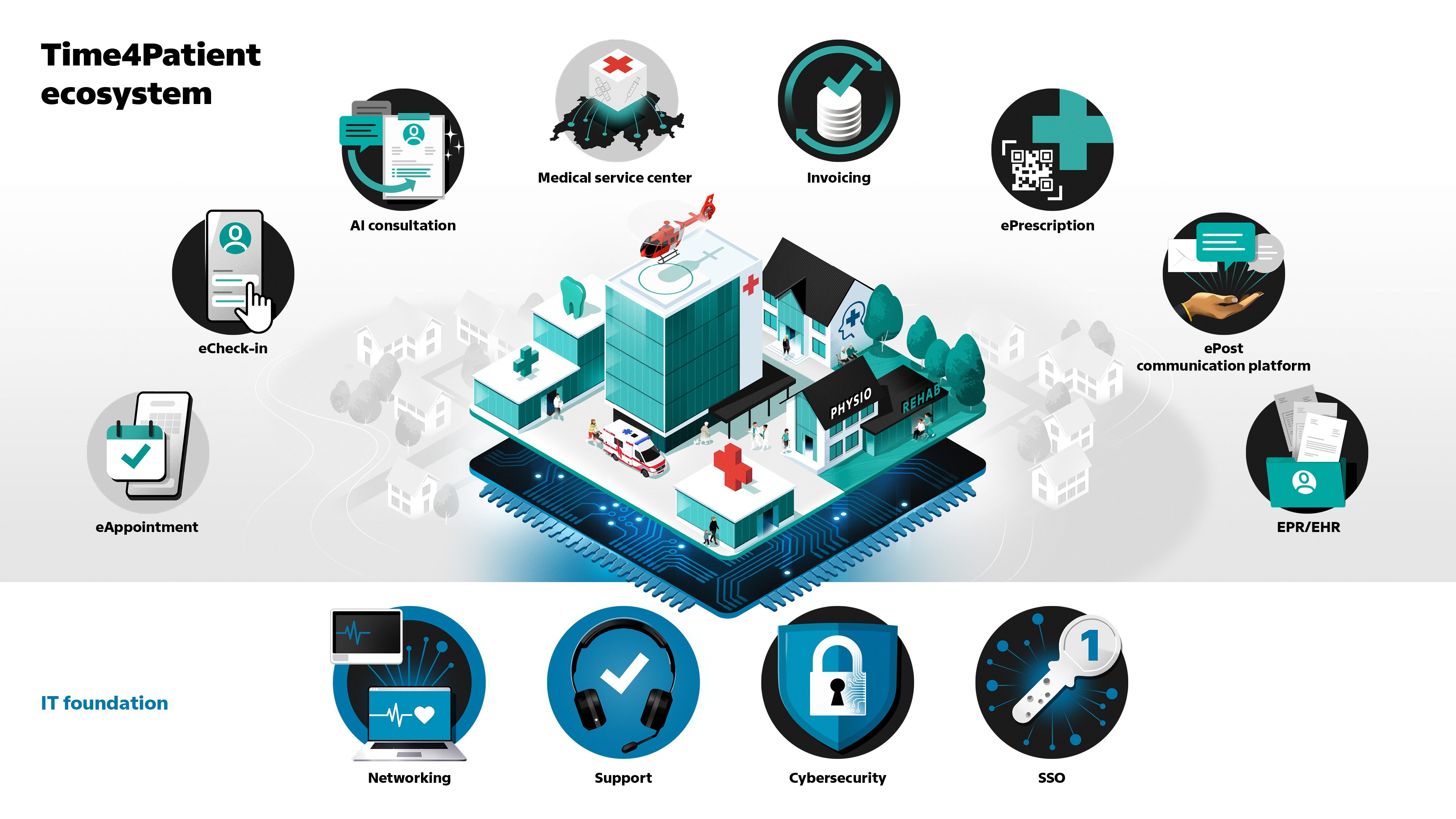
In order to release the full potential, the IT foundation must be standardized and centralized: i.e. uniform processes, clear standards, fewer dependencies. This results in stable, secure and cost-efficient IT that provides optimal support for healthcare organizations – such as Swiss Post’s all-in IT solution Time4Patient. When implemented correctly, this foundation reduces complexity in everyday work and creates more time for patient care. But it also makes processes for patients simpler, more transparent and more digital. Pascal Brack summed it up clearly at the end: “First the foundation, then processes and then innovation.”
What a stable IT foundation means in practice
The input from Marcel Napierala, CEO of Medbase Group, impressively showed how the company combines services, data and partners into an integrated supply system. This system connects everything from prevention, diagnostics and therapy to pharmacies, telemedicine and care.
For this networking to work, a cross-location data and process landscape is required: a common IT infrastructure ensures that information is able to flow between all locations and that collaboration is easier. The integration of other partners, such as insurers, hospitals and specialist departments that round off the medical care system, is also key. This integrated approach increases quality and efficiency and creates the basis for consistent orientation towards the needs of patients.
From the digital process to the medical care system
In the subsequent input, Corinne Spirig, COO of the digital health center bülach (dhc), showed us where the journey might lead. When it comes to reducing workload in the healthcare sector, it’s often a question of efficiency within individual organizations. However, the greatest frictional losses occur at the transitions in the treatment path.
One typical example is the transfer from a GP practice to a specialist. Missing information, follow-up requests for documents or duplicate clarifications regularly lead to additional coordination efforts and take up valuable time for specialists.
Processes therefore need to be optimized not only locally, but also along the entire patient journey. Today, many organizations are improving their processes within their own structures. In the future, however, it will be important for the healthcare system to design processes that work across sectors. Corinne Spirig is convinced: “In the coming years, we will see many good digital solutions. The real leverage, however, lies in how well these solutions interact in the medical care system.”